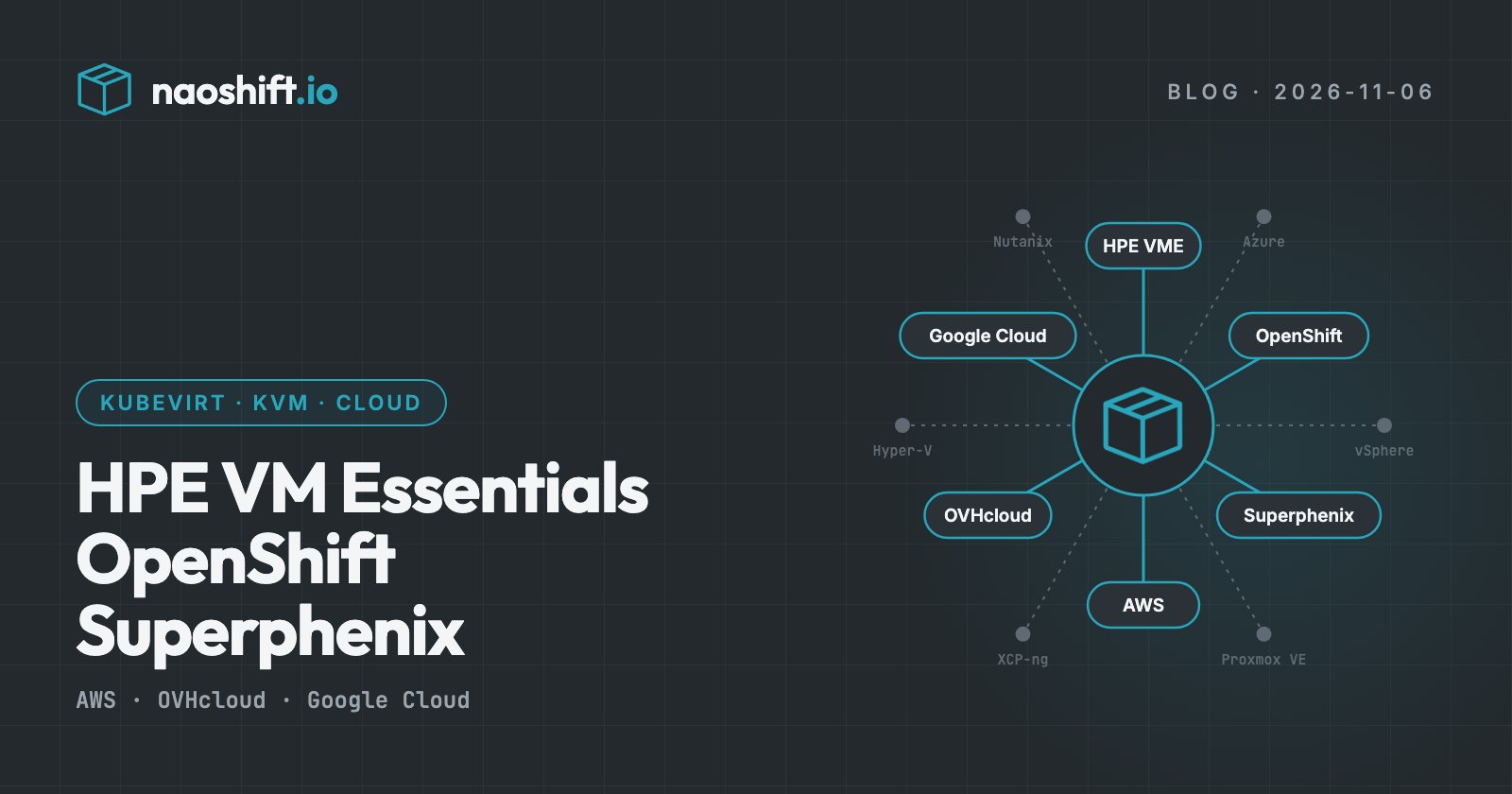
NaoShift now supports HPE VM Essentials, OpenShift and Superphenix
HPE Morpheus VM Essentials, Red Hat OpenShift Virtualization and Superphenix join the NaoShift console, along with AWS, OVHcloud Public Cloud and Google Cloud. What each connector reads, and how it connects.
After VMware, the virtualisation landscape is fragmenting. Alongside Proxmox VE, XCP-ng, Nutanix AHV and Hyper-V, new platforms are settling in at IT departments and hosting providers: HPE Morpheus VM Essentials, Red Hat OpenShift Virtualization, or Superphenix, Rayshift's sovereign platform. Many organisations run several of them at once.
In early November, NaoShift adds these three platforms to its console, together with three public clouds: AWS, OVHcloud Public Cloud and Google Cloud, next to Microsoft Azure. The goal does not change: all your hypervisors, in one console.
These connectors are in early access: they are shipped and tested, but have not yet run on a customer's infrastructure. If you use one of these platforms, we would be glad to carry out the first deployment with you.
OpenShift Virtualization and Superphenix: one KubeVirt connector
Red Hat OpenShift Virtualization and Superphenix both rely on KubeVirt, which runs virtual machines inside Kubernetes. NaoShift therefore reads them with a single collector, through the cluster's Kubernetes API.
Superphenix, developed by Rayshift, is an open source platform aimed at hosting providers and sovereignty-minded organisations. It combines Talos, KubeVirt, Kube-OVN and Rook-Ceph. NaoShift also reads its own topology, by region and availability zone. The connector has been tested on a real Superphenix installation in our lab.
How it connects: a Kubernetes service account and a read-only cluster role, with no access to secrets. The collector only queries a closed list of resources. It never reads the machines' annotations or cloud-init configuration, which may contain passwords.
What it brings back:
- the nodes that run virtual machines, the machines themselves, their disks and their network adapters;
- namespaces, shown as containers, and storage classes, shown as datastores;
- each machine's high availability, derived from its run strategy;
- machine performance through Prometheus (Thanos on OpenShift), node performance through metrics-server.
When an incident occurs, root-cause analysis reads the Kubernetes events and live migrations related to the machine, its pod, its volumes and its node. Since Kubernetes only keeps these events for about an hour, the analysis needs to start early.
HPE Morpheus VM Essentials
HPE VM Essentials is HPE's KVM-based virtualisation platform, driven by the VME Manager, which can also manage vCenter clusters.
How it connects: an API token from a read-only VME Manager user, over HTTPS, with optional certificate pinning. The collector only queries a closed list of routes, and strips on receipt the sensitive fields the API returns (console passwords, keys, user data).
What it brings back: VM Essentials clusters, their hosts, their machines, their datastores with size and free space, and snapshots.
No double counting: vCenter clusters driven by the VME Manager are excluded and counted separately, so that they do not appear twice if your vCenter is already connected to NaoShift.
When an incident occurs, root-cause analysis reads the VME Manager activity, which tells who did what, the machine and cluster history, and the appliance alarms.
Also new: AWS, OVHcloud Public Cloud and Google Cloud
Public cloud virtual machines join the same console. For these connectors, nothing needs to be installed: NaoShift queries the provider's API, read-only, with a dedicated account. Each cloud account appears as a datacenter and each region as a cluster. Ephemeral machines (auto scaling groups, Kubernetes nodes) are excluded and counted, so that they do not distort the inventory.
What it changes for an operations team
Whatever the platform, a machine ends up in the same inventory, with the same risk analyses, the same reports and the same incident analysis. A team testing OpenShift Virtualization, deploying HPE VM Essentials on its new servers, or entrusting part of its estate to a hosting provider running Superphenix keeps a single view of the whole.
As with the other platforms, collection goes through the outbound agent, read-only by default. Write actions on these new platforms are planned for a second phase, with the same rule: write access enabled per target with a dedicated account, logged before execution.
Frequently asked questions
Does NaoShift support OpenShift Virtualization?
Yes, in early access, through the cluster's Kubernetes API, with a read-only service account. The same connector covers Superphenix and other KubeVirt platforms.
How does NaoShift avoid counting twice the VMs of a vCenter managed by HPE VM Essentials?
vCenter clusters driven by the VME Manager are excluded from the VM Essentials collection and counted separately. Their machines remain visible through the vCenter connector.
What is Superphenix?
An open source virtualisation platform developed by Rayshift, built on KubeVirt, Talos, Kube-OVN and Rook-Ceph, and designed for hosting providers and sovereign clouds.
Going further
The Integrations page lists every supported platform. To carry out the first deployment of one of these connectors with us, write to us, or start for free.