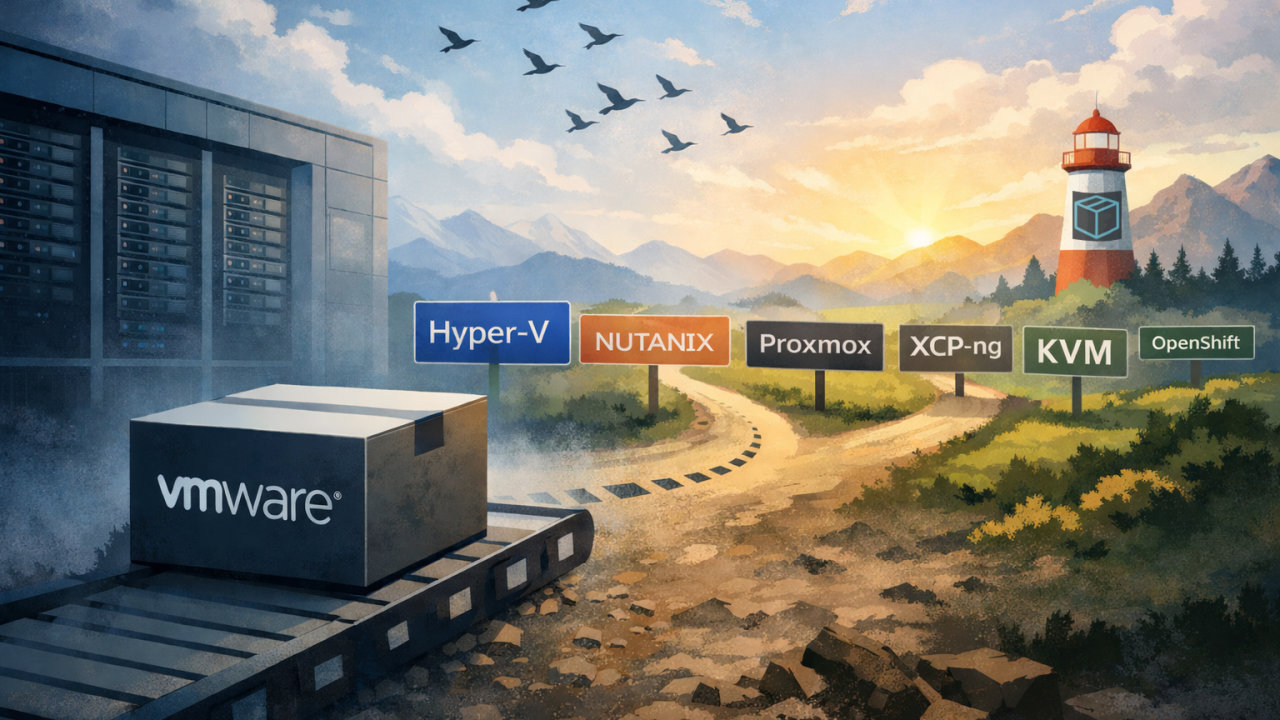
VMware: What I’m Actually Seeing in the Field
Explore how companies are reassessing their reliance on VMware amid evolving IT landscapes, discovering alternatives, and optimizing infrastructure for a more resilient future
VMware and the Evolution of IT Infrastructure: An In-Depth Analysis
The rapid evolution of information technologies has forced companies to rethink their use of virtualization platforms, particularly VMware, once considered untouchable. This article explores how organizations are reassessing their dependence on VMware, the alternatives they are considering, and how they can optimize their IT infrastructure for the future.
VMware’s Impact on IT Infrastructure
VMware is a pioneering company in virtualization, enabling organizations to maximize the use of their hardware resources. VMware virtualization consists of creating multiple virtual machines on a single physical server, thereby optimizing efficiency and reducing hardware costs. According to industry studies, 80% of Fortune 1000 companies use VMware for their IT infrastructure, highlighting its central role in virtualization.
However, relying heavily on a single platform can become a limitation when economic or technological conditions change. Around 60% of surveyed companies reported that they are reevaluating their use of VMware due to evolving licensing costs and increasing competition.
VMware Alternatives: Diversifying Solutions
Alternatives to VMware are rapidly expanding, giving companies a variety of options to meet their specific needs. Here are some of the most popular alternatives:
- Microsoft Hyper-V – Easy integration with existing Windows environments.
- XCP-ng – An open-source solution offering simplicity and greater control.
- Nutanix – A hyperconverged platform promising seamless integration.
- OpenShift and Kubernetes – Focused more on applications than virtualization itself.
- KVM (Kernel-based Virtual Machine) – An open-source option for regaining control over infrastructure.
These solutions allow companies to diversify their infrastructure and reduce dependency on a single technology. According to a Gartner study, 45% of organizations plan to adopt a multi-cloud approach by 2025 to avoid vendor lock-in.
Reducing Dependency: Toward a Flexible IT Infrastructure
Dependence on a single platform can limit a company’s ability to adapt to technological and economic changes. To address this, organizations are adopting strategies such as:
- Infrastructure as Code (IaC) – Automating infrastructure management to increase flexibility.
- Blueprints and Pattern Catalogs – Reusable models for vendor-independent architectures.
- Multi-cloud – Using multiple cloud providers to avoid dependency on a single vendor.
- Hybrid Cloud Solutions – Combining public and private clouds for maximum flexibility.
These strategies enable companies to remain agile and respond quickly to market changes.
NaoShift: A Leader in IT Infrastructure Optimization
At NaoShift, we understand the importance of reducing dependency on a single technology. Our IT infrastructure optimization solutions help companies maximize infrastructure efficiency while minimizing costs. Our experts work closely with clients to design flexible and scalable architectures tailored to their specific needs.
NaoShift also provides cloud migration services, helping businesses safely transition from VMware to alternative platforms. By partnering with NaoShift, organizations can benefit from our expertise in capacity planning to optimize resource utilization and reduce operational costs.
To learn more, visit our NaoShift website or explore our NaoShift blog.
FAQ
Why are companies reevaluating their use of VMware?
Organizations are reevaluating VMware due to evolving licensing costs, new regulatory requirements, and the emergence of more flexible and cost-effective alternative technologies.
What are the main alternatives to VMware?
The main alternatives include Microsoft Hyper-V, XCP-ng, Nutanix, OpenShift, Kubernetes, and KVM, each offering unique advantages in terms of integration, cost, and control.
How can NaoShift help with the transition to a new platform?
NaoShift provides consulting and migration services to help companies move from VMware to alternative platforms, ensuring a smooth and efficient transition. Our solutions are designed to optimize IT infrastructure and reduce costs.
Conclusion
The future of IT infrastructure lies in flexibility and adaptability. By diversifying their virtualization platforms and adopting strategies such as Infrastructure as Code, companies can not only reduce dependency on a single technology but also improve their ability to innovate and adapt to an ever-changing environment. NaoShift is proud to support organizations through this transition, transforming challenges into opportunities for optimization and growth.